



Types of jellyfish in Thailand: dangerous and harmless, and how to tell them apart
Most jellyfish you see in Thailand will not seriously hurt you, but a few can. Telling them apart on the beach is not always possible, so it helps to know the shape of each group and which ones to treat as an emergency.
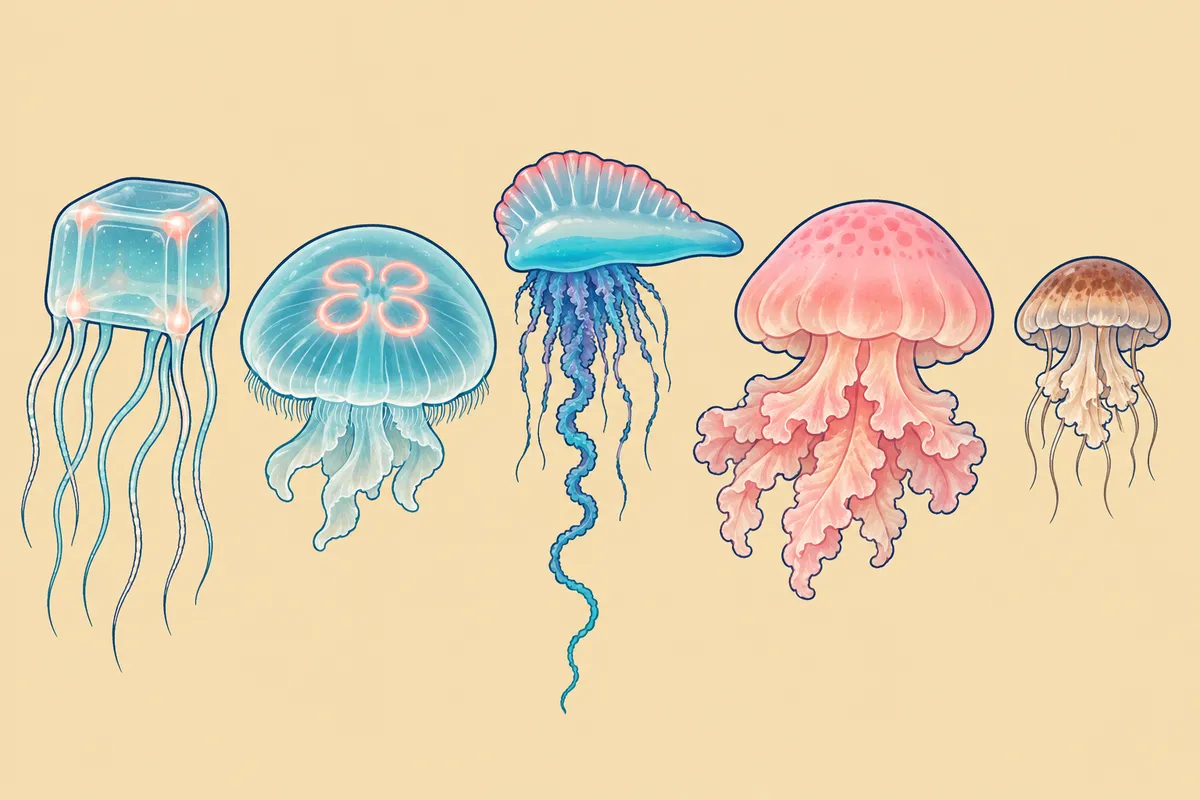
The 30-second version
- A **transparent cube** with long thin tentacles from its corners is a box jellyfish. Dangerous. Out of the water, vinegar, 1669.
- A **blue bubble or bottle** on the surface or on the sand with long blue tentacles is a bluebottle (Portuguese man o' war). Painful, can be serious. Do not touch it, even stranded.
- A **flat, saucer-shaped bell with reddish stripes and long thin tentacles** is the "fire jellyfish" (sea nettle). Painful.
- A **clear saucer with four pink or violet rings** is a moon jellyfish. Usually barely felt.
- A **domed bell dotted with white spots** is a white-spotted jellyfish. Harmless to most people.
- A **small flat disc with blue fringe**, sometimes in thousands on the sand, is a blue button or by-the-wind sailor. Mild.
If you are not sure what stung you, treat it as a box jellyfish sting. That covers the worst case.
Box jellyfish: the group that can kill
Box jellyfish have a cube-shaped bell and swim actively. They are almost transparent, usually invisible in shallow water. Four kinds are recorded in Thai waters, and non-specialists cannot tell most of them apart:
- **Chironex (Chironex indrasaksajiae):** each corner has a fleshy arm carrying a bundle of up to 12 tentacles. The bell can reach 15 to 17 centimetres and the tentacles about 3 metres. Described scientifically only in 2017, it is linked to most jellyfish deaths in Thailand. Danger level in our guide: highest.
- **Chiropsoides:** branched, finger-like arms with one thin tentacle per finger. It is found nearly all year in the Gulf and on the Andaman coast. The sting is usually milder than Chironex but very painful.
- **Morbakka:** one flat pink-mauve tentacle per corner and a bell dotted with small pinkish warts. Its sting can cause an Irukandji-like syndrome: back and muscle pain, racing heart, high blood pressure, nausea and anxiety, starting 5 to 40 minutes after the sting.
- **Tripedalia:** tiny, about 1 cm, living in mangroves and sheltered bays. Mild, but easy to mistake for a young dangerous one.
Read the full account in our box jellyfish guide. For first aid, vinegar for at least 30 seconds is the step recommended for stings that may be box jellyfish or Irukandji-type.
Bluebottle (Portuguese man o' war) and its lookalikes
The bluebottle, Physalia, is not a true jellyfish but a colony of organisms under a gas-filled float that drifts on the surface and is blown ashore by wind. The float is translucent blue-violet, usually 3 to 15 centimetres, with a low crest on top and long bright-blue tentacles that can coil into spirals and trail several metres. The sting is very painful and can sometimes cause a whole-body reaction. Tentacles of stranded bluebottles still sting, so do not pick one up.
Two relatives look like small blue discs and often wash up in large numbers: the **blue button** (Porpita), a flat golden-brown disc with a bright blue fringe up to about 3 cm across, and the **by-the-wind sailor** (Velella), a deep-blue oval float with a thin clear triangular sail. Both are usually mild, though the blue button can burn. In Phuket in May 2026, DMCR found blue buttons and by-the-wind sailors washed up on Karon beach together with bluebottles, which is a good rule of thumb: where you see small blue discs, check for bluebottles.
Saucer-shaped jellyfish: painful, rarely dangerous
- **Sea nettle, "fire jellyfish" (Chrysaora):** creamy, translucent bell 10 to 20 cm across with reddish-brown radiating stripes and many long thin reddish tentacles. Found year-round on both coasts, often in numbers. The sting is usually not life-threatening but burns and takes time to settle. In March 2026 DMCR reported blooms of a related genus, Pelagia, about 2 to 3 cm across, at several southern Phuket spots.
- **Lion's mane (Cyanea buitendijki):** a broad, flat yellowish to orange-red bell 10 to 30 cm across with eight dense bundles of very fine tentacles. The sting is usually moderate but the tentacles can cover a large area of skin.
- **Hairy jellyfish (Lobonema):** a thick, milky-white bell covered with pointed projections and no fine tentacles around the rim. It is fished and eaten in Thailand. Alive, it stings.
- **Edible jellyfish (Rhopilema) and other root-mouth jellyfish:** a large firm bell, 20 to 50 cm, rough with small warts, with thick oral arms and no tentacles around the rim. The sting is usually mild but some people get a long-lasting itchy rash.
Mild and harmless kinds
- **Moon jellyfish (Aurelia aurita):** one of the most recognisable jellyfish in the world: a wide, flat, clear saucer with four pink, violet or milky horseshoe rings. Its sting is usually barely felt.
- **White-spotted jellyfish (Phyllorhiza punctata):** a domed translucent bell in light brown, bluish or olive, dotted with white spots. Divers often see it around Koh Tao and Koh Phangan. The sting is very weak; most people feel nothing.
Comparison table
| Name | Looks like | Danger | When and where |
|---|---|---|---|
| Chironex box jellyfish | Transparent cube, bundles of tentacles at corners | Can be fatal | Gulf peak July to November; also Andaman |
| Chiropsoides box jellyfish | Transparent cube, finger-like arms | Very painful | Almost year-round, both coasts |
| Morbakka | Taller cube, one flat tentacle per corner | Delayed serious symptoms possible | Almost year-round, both coasts |
| Bluebottle | Blue bubble float, long blue tentacles | Very painful, can be serious | Monsoon wind, Andaman June to September |
| Sea nettle ("fire jellyfish") | Creamy bell with reddish stripes | Painful | Year-round, both coasts |
| Lion's mane | Flat orange-red bell, fine tentacle bundles | Moderate | Mostly the Gulf |
| Blue button | Small round disc with blue fringe | Mild | Washes up in numbers |
| Moon jellyfish | Clear saucer with four rings | Barely felt | Calm water, both coasts |
| White-spotted jellyfish | Domed bell with white dots | Harmless to most | Around Koh Tao, Koh Phangan |
Each species has its own illustrated page, with where and when it occurs, in the jellyfish field guide, for example Chironex, bluebottle and moon jellyfish.
What to do on the beach
- Do not touch any jellyfish on the sand, even a dead-looking one. Stranded tentacles still sting.
- Look at the forecast and recent reports: Phuket, Koh Samui and Koh Phangan are good starting points. Our season page shows the months.
- If stung and unsure: out of the water, vinegar for at least 30 seconds, tweezers for tentacles, call 1669 if the sting is large or you feel unwell. See first aid and why urine and fresh water are not the answer.
- Photograph the animal if you safely can. Doctors use a photo to choose treatment.
Questions and answers
What types of jellyfish are in Thailand?
Box jellyfish (Chironex, Chiropsoides, Morbakka and Tripedalia), bluebottles (Portuguese man o' war), fire jellyfish or sea nettles, lion's mane, hairy and edible jellyfish, blue buttons, by-the-wind sailors, moon jellyfish and white-spotted jellyfish are all recorded in Thai waters.
Which jellyfish in Thailand is the most dangerous?
The Chironex box jellyfish, which is linked to most jellyfish deaths in the country. It is transparent and usually invisible in shallow water.
How do I tell a box jellyfish from other jellyfish?
Look for a transparent cube-shaped bell with tentacles hanging from its four corners. In practice you often cannot see it in the water, so rely on warnings, lifeguards and the forecast.
Are moon jellyfish dangerous in Thailand?
No. Their sting is usually barely noticeable, though they often gather in large groups in calm water.
Are the blue discs on the beach dangerous?
Blue buttons and by-the-wind sailors are usually mild, but they often wash up with bluebottles, which sting painfully. Do not touch any of them.