



Jellyfish in Krabi: Ao Nang, Railay, Koh Lanta and Phi Phi by season
Krabi gets far fewer official jellyfish warnings than its neighbour Phuket, but visitors do meet jellyfish here, mostly in the calm months from January to May. The pattern differs between the sheltered bays of Ao Nang and Railay, the long west-facing beaches of Koh Lanta and the island bays of Phi Phi.
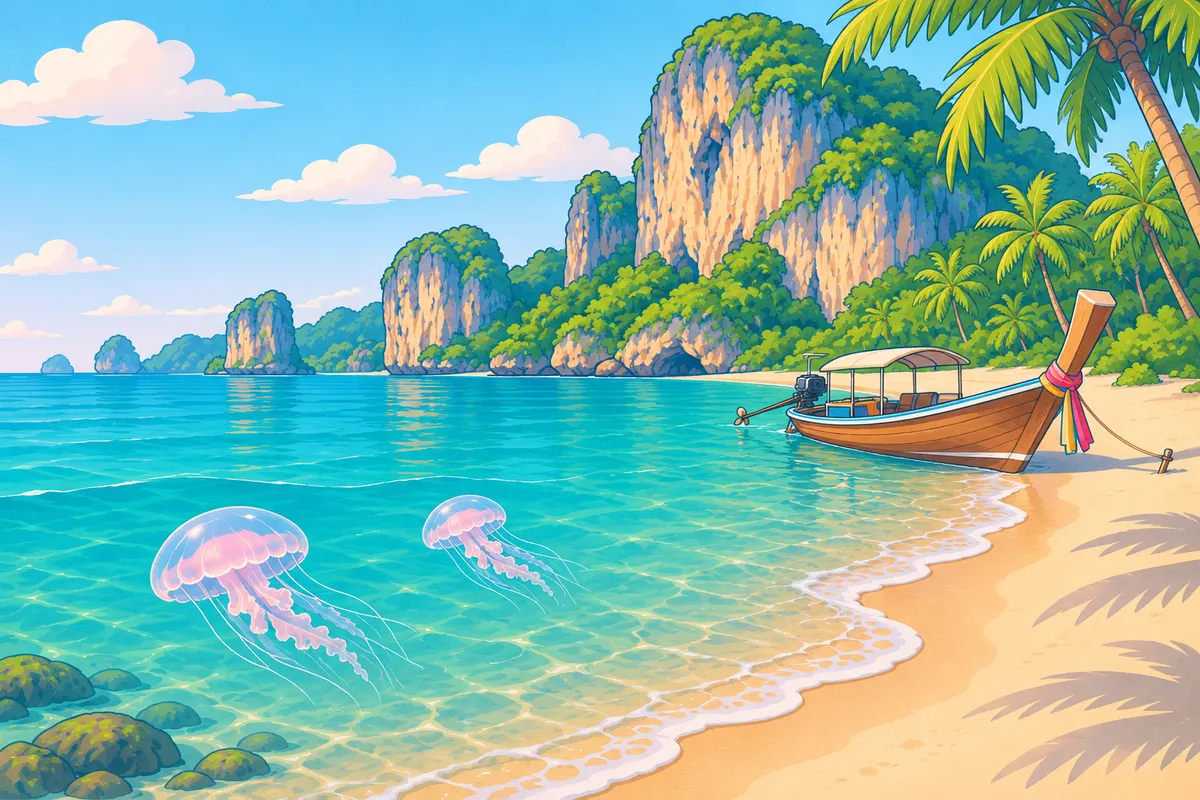
How the jellyfish year looks in Krabi
Krabi sits on the Andaman Sea, east of Phuket, and its weather follows the same two monsoons. From about November to April the north-east monsoon brings dry, settled weather, light offshore breezes and flat water. From about May to October the south-west monsoon turns the wind around: it blows from the sea onto the shore, waves build and rain comes in heavy showers.
Jellyfish respond to both halves of that year, but in different ways. In calm, warm water, jellyfish that swim or drift slowly gather in bays and near islands, and small stinging species bloom. When the wind turns onshore, floating animals such as bluebottles are pushed toward the beaches, and the surf mixes everything up. For Krabi, the first half of the year matters more.
| Months | Onshore wind | Jellyfish sightings reported | What it means |
|---|---|---|---|
| January to February | On 9 to 13% of days | Steady: 26 in January, 15 in February | Calm, clear water; occasional small stingers near islands |
| March to April | On 25% of days in March, 60% in April | The peak: 63 in March, 49 in April | Main jellyfish season; April has the most days with elevated risk |
| May | On 68% of days | 14 | Transition: wind turns onshore, sea gets choppy |
| June to September | On 89 to 94% of days | Few: from 28 in June down to 2 in September | Monsoon surf and red flags limit swimming more than jellyfish do |
| October to December | On 13 to 50% of days | Low: 8 to 9 per month | Quiet season returns |
The sightings column counts eyewitness reports from social media, beach reviews and users of this site across all years we hold, so it shows when people meet jellyfish, not how many are in the sea. The pattern is clear all the same: March and April stand out. The Krabi page shows the same calendar as a chart, with the forecast for each beach today, and each month has its own page, such as Krabi in April.
What official warnings say
Thailand's Department of Marine and Coastal Resources (DMCR) publishes a list of jellyfish warnings when stings, strandings or blooms are reported. From January 2024 to September 2026 the list contains 47 entries for the whole country. Krabi has one of them: a seasonal advisory for Koh Lanta covering 1 April to 31 July 2024, which named bluebottles, box jellyfish and other stinging jellyfish as possible in that period and advised against water activities. For comparison, Phuket has 19 entries in the same period (see our Phuket guide).
Older DMCR notices fill in the picture. In October 2017 the department's Krabi unit reported a bloom of the fire jellyfish Pelagia panopyra, deep pink in colour, around Koh Hong and Koh Lao Lading in Ao Luek district. DMCR described the venom as not severe but causing burning pain, and advised pouring vinegar over the sting for 30 seconds to a minute, with no fresh water and no rubbing with sand. In June 2022 the Than Bok Khorani National Park put up red flags on Koh Hong after fire jellyfish washed up and floated near the beach when the wind changed; park staff expected them to clear within a day or two once the waves calmed.
Krabi's typical jellyfish encounter is a pinkish fire jellyfish or another small stinger in calm water around the islands, most often in March and April. It hurts, but it is a different problem from the box jellyfish cases of the Gulf islands.
Why so few warnings, when visitors report jellyfish every year? Part of it is geography: the main Krabi beaches face south-west into the shelter of Phang Nga Bay and the offshore islands, so they get less of the open-sea drift that hits Phuket's west coast. Part of it is reporting: a warning is issued when lifeguards, park staff or the public notify DMCR, and Phuket has a larger, organised lifeguard network. Treat "no warning" as "nothing reported", not "nothing there".
Which jellyfish you can meet in Krabi
- **Fire jellyfish (Pelagia and sea nettles).** Small, pink to purple, often in dense patches near Koh Hong, Koh Lao Lading and the Phi Phi islands in the dry season. Burning pain and a red rash that can itch for days. See the sea nettle profile.
- **Box jellyfish.** Several species live on the Andaman coast, including Chiropsoides and Morbakka. They are almost transparent and hard to see. The most severe Thai cases have been on Koh Samui and Koh Phangan, but any unknown sting should be treated as a possible box jellyfish.
- **Bluebottles (Portuguese man o' war).** Blown in by onshore wind in the monsoon months, more often on Phuket and Phang Nga than in Krabi. On Koh Lanta's long west-facing beaches they are possible from May onward. Read our bluebottle guide.
- **Harmless or mild jellyfish.** Large rhizostome jellyfish and moon jellies sometimes drift into Ao Nang and Klong Muang. Many sting little or not at all, but do not handle any jellyfish, even on the sand.
Our types of jellyfish guide has photos and a quick way to tell the dangerous ones from the rest.
Beach by beach: Ao Nang, Railay, Koh Lanta, Phi Phi
| Beach or area | Setting | Jellyfish notes |
|---|---|---|
| [Ao Nang](/en/thailand/krabi/ao-nang), [Noppharat Thara](/en/thailand/krabi/noppharat-thara) | Main mainland beaches, south-west facing, shallow sandy water | Sightings concentrate in March and April; in the monsoon the sea is murky and choppy |
| [Railay West](/en/thailand/krabi/railay-west), [Phra Nang](/en/thailand/krabi/phra-nang), [Tonsai](/en/thailand/krabi/tonsai-krabi) | Small bays between limestone cliffs, reached by longtail boat | Calm water favours drifting jellyfish in the dry season; ask the boat drivers and beach staff |
| [Klong Muang](/en/thailand/krabi/klong-muang), [Tubkaek](/en/thailand/krabi/tubkaek) | Quieter resort beaches north of Ao Nang | Similar season; fewer people in the water, so fewer reports |
| [Koh Hong](/en/thailand/krabi/koh-hong-krabi) | National park island and lagoon on the island-hopping route | Fire jellyfish blooms recorded by DMCR and the park in 2017 and 2022 |
| [Koh Lanta](/en/thailand/koh-lanta): Klong Dao, Long Beach, Kantiang | Long west-facing beaches open to the Andaman Sea | The only Krabi area with a DMCR advisory (April to July 2024); more exposed to onshore wind and bluebottles than Ao Nang |
| [Koh Phi Phi](/en/thailand/koh-phi-phi): Loh Dalum, Long Beach, Maya Bay | Island bays facing different directions | Few reports; small stingers possible on snorkelling trips around the islands |
On Koh Lanta, the forecast for each beach is on the Koh Lanta page, for example Long Beach or Klong Dao. For Phi Phi, see Loh Dalum Bay.
Island-hopping and snorkelling trips
Day trips deserve their own plan: the four-island tour, Koh Hong, Phi Phi and the Hong islands. You spend time floating in open water with your face down, often in a group, and the boat stops at whichever bay is calm that day. That is exactly where drifting jellyfish collect in the dry season.
- Ask the boat crew before you get in: "Any jellyfish today?" Crews see the water every day and often know which bay has them.
- Wear a long-sleeved rash guard or a full-body lycra suit for snorkelling. It stops most stings on the covered skin; see our stinger suit guide.
- Check whether the boat carries vinegar. If not, bring a small bottle of plain white vinegar yourself; it is sold in convenience stores and supermarkets all over Krabi.
- Children and anyone with allergies should stay close to the boat and come out at the first prickling feeling.
- If someone is stung on a boat, the crew can radio ahead. Note the name of the boat and the bay in case you need a hospital.
A simple plan for swimming in Krabi
- Before you go, open the forecast for your beach. It combines the season, wind, waves and recent reports.
- From January to May, look at the water before you go in. Pink or purple blobs, or lots of small clear ones, mean stay out or wear a suit.
- From June to October, waves and currents are the bigger danger. Respect red flags and read what the flags mean.
- Walk the tideline. Jellyfish on the sand are a good sign that there are more in the water.
- Swim near other people and, where they exist, near lifeguards.
- After a sting you cannot identify, pour vinegar over it for at least 30 seconds, lift off tentacles with tweezers, and see the first-aid guide. Do not use fresh water or urine; our article on urine, vinegar and hot water explains why.
- Call 1669 for breathing trouble, chest pain, fainting, a large area stung, or a stung child. Krabi Hospital in Krabi town has an emergency department.
Seen jellyfish on a Krabi beach, or none at all? Report it in 20 seconds. Each report shows on the map and helps the next visitor.
Questions and answers
Are there jellyfish in Krabi?
Yes. Most sightings come in the dry season, from January to May, with a peak in March and April. Fire jellyfish and other small stingers are the usual kinds; box jellyfish and bluebottles are possible but less common than in other parts of Thailand.
When is jellyfish season in Krabi?
March and April are the peak months for jellyfish sightings around Ao Nang, Railay and the islands. From June to October jellyfish are reported less often, and waves and currents become the main danger.
Are there box jellyfish in Krabi?
Box jellyfish species are recorded on the Andaman coast, including Krabi, and DMCR listed them among possible species in its 2024 Koh Lanta advisory. Severe cases in Thailand are concentrated in the Gulf, but treat any unknown sting as a possible box jellyfish and use vinegar.
Is it safe to swim at Railay and Ao Nang because of jellyfish?
Usually yes. Check the forecast and the water, wear a rash guard in March and April, carry vinegar, and get out at the first prickling feeling.
Are there jellyfish on Koh Lanta?
Yes. DMCR issued a seasonal jellyfish advisory for Koh Lanta from April to July 2024, and visitors report jellyfish there in most months, more often from December to April and in June. Koh Lanta's west-facing beaches are also more exposed to bluebottles in the monsoon.
What do I do if I get stung in Krabi?
Leave the water, pour vinegar over the sting for at least 30 seconds, remove tentacles with tweezers and call 1669 if the sting is large or you feel unwell. Do not rinse with fresh water or rub the skin.