



Jellyfish in Phuket: seasons, species and which beaches get warnings
Phuket has jellyfish all year, but not the same ones. Bluebottles arrive with the monsoon wind, other stinging jellyfish bloom in the dry season, and a handful of beaches collect most of the official warnings. Here is how the pattern looks in three years of reports.
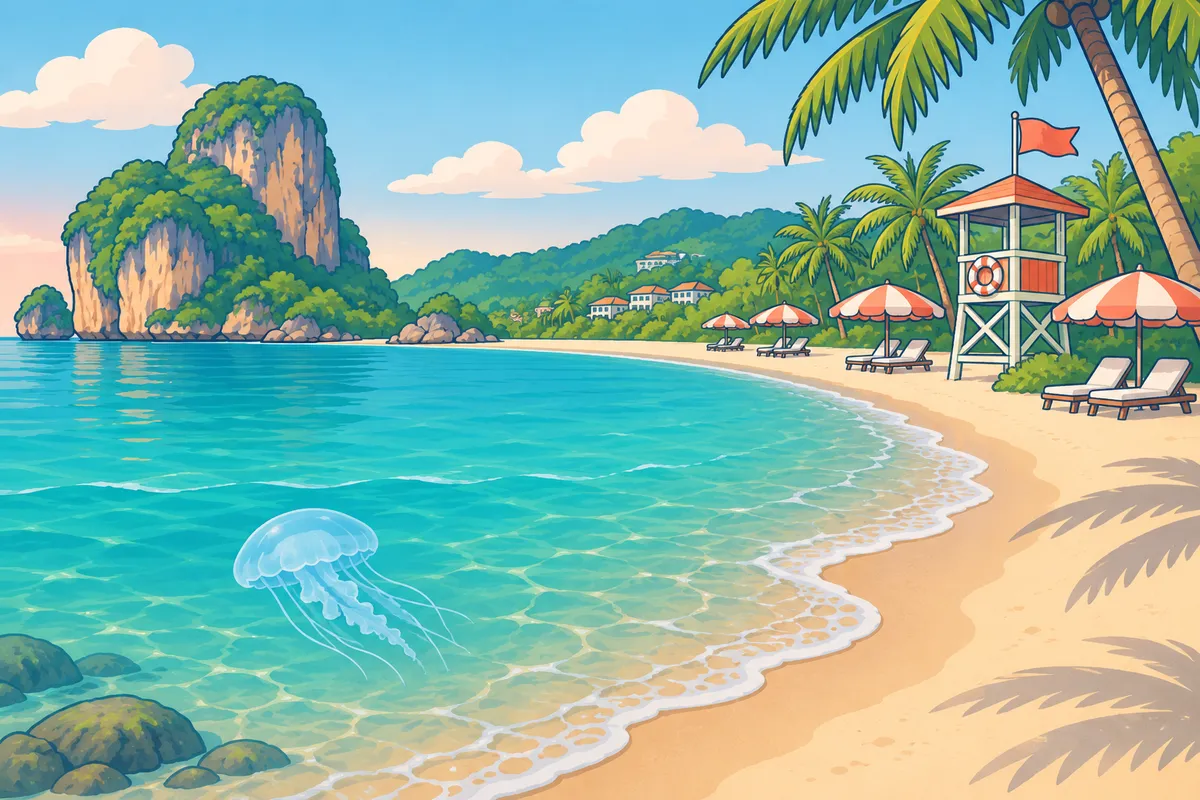
Two seasons, two kinds of jellyfish
Phuket faces the Andaman Sea, and its weather follows the south-west monsoon from roughly May to October. That shapes what you see on the beach.
- **June to September: bluebottles.** The wind blows from the sea to the shore, and Portuguese man o' war (bluebottles) drift in with it, especially on the open west coast after several days of steady westerly wind. They are not true jellyfish but colonies under a blue gas float, and tentacles of stranded ones still sting.
- **January to April: other stinging jellyfish.** The sea is calm and visitors report large rhizostome jellyfish, small lilac jellyfish and stinging plankton, rather than bluebottles. The peak is usually in January, and in some years there is a second wave in March.
Our season page shows the official warnings by month for the Andaman coast, and the Phuket page gives a daily forecast for each beach combining season, wind, waves and reports.
What official warnings say: 19 warnings, 14 about bluebottles
The Department of Marine and Coastal Resources (DMCR) issues a warning when stings or strandings are reported. We collected the DMCR jellyfish warnings from June 2024 to September 2026 and counted the Phuket ones. There are 19 in that period. Fourteen are for bluebottles (Physalia; see our bluebottle guide), three for other stinging jellyfish, one for a box jellyfish, and one without a species. These are reports, not a count of every sting, so they show where lifeguards and the public notify DMCR, not the true incidence.
| Period | Warnings | What was reported | Where |
|---|---|---|---|
| June 2024 | 2 | Bluebottles stranded at Karon Noi; tourists stung by bluebottles on Koh Racha Yai, with 3 serious cases and 7 taken to hospital for observation | Karon Noi, Ao La and Ao Thue (Koh Racha Yai) |
| July to September 2025 | 5 | Bluebottles | Karon, Kata, Patok Bay (Koh Racha Yai) |
| December 2025 | 1 | Box jellyfish | Yon Bay |
| March 2026 | 4 | Bluebottle at Karon; fire jellyfish (Pelagia) blooms at several southern spots | Karon, Mai Thon, Siam Bay and Koh Aeo |
| May to June 2026 | 6 | Bluebottles and other floating relatives (blue buttons, by-the-wind sailors) | Karon, Patok Bay, Mai Khao, Laem Phan Wa |
| September 2026 | 1 | Tourists injured after contact with jellyfish; red flags up for waves | Nai Thon |
Three patterns stand out. First, bluebottle warnings cluster in the monsoon months, with a burst in late May and June 2026 at Karon when waves of 2 to 3 metres were reported on the day. Second, Karon and Kata are the beaches that appear again and again, which is what you would expect from long, exposed west-facing beaches with onshore wind and active lifeguard networks that report. Third, March 2026 brought a different picture: DMCR reported fire jellyfish of the genus Pelagia floating in dense numbers, about 40 per 100 metres of surface water at Mai Thon, spread along both sides of Siam Bay on Koh Racha Yai, and at around 100 per square metre at Koh Aeo, in calm conditions. These are small animals, around 2 to 3 centimetres across, that cause burning pain, irritation and red rash on contact.
Beach by beach
| Beach or area | Seen in reports | Practical note |
|---|---|---|
| Karon, Kata, Karon Noi | Most frequent: bluebottles in June to September and again in March and May 2026 | Long west-facing beaches; check the tideline after a few days of westerly wind and ask lifeguards |
| Patong and Kamala | No warnings in our data | Same monsoon exposure; no warnings does not mean no jellyfish, only that none was reported to DMCR |
| Nai Thon, Mai Khao (north-west) | Warnings in May and September 2026 | Strong waves and red flags in the monsoon; swimming is limited by waves before jellyfish |
| Rawai, Koh Aeo, Mai Thon (south and islands) | Pelagia blooms in March 2026 | Calm dry-season water, but the stinging bloom was dense |
| Koh Racha Yai (Siam Bay, Patok Bay, Ao La) | Reports in 2024, 2025 and 2026 | Popular boat-trip bays; ask the boat crew about recent reports |
| East and south-east (Laem Phan Wa, Yon Bay) | Bluebottles at Laem Phan Wa in June 2026; a box jellyfish warning at Yon Bay in December 2025 | Sheltered bays are calmer, but follow the same first-aid rules |
The pattern across beaches reflects both nature and reporting, so read it as a guide to where to look rather than a ranking of danger. For a specific beach, open its page for today's forecast: for example Karon, Kata or Patong.
What about box jellyfish in Phuket?
Box jellyfish are recorded on the Andaman coast, including Phuket, and DMCR logged a box jellyfish warning at Yon Bay in December 2025. The two species most often found on this coast are Chiropsoides, whose sting is usually milder than Chironex but very painful, and Morbakka, which can cause delayed whole-body symptoms. By contrast, the most severe and fatal cases in Thailand have been recorded on Koh Samui and Koh Phangan in the Gulf. For more on that difference and on the animals themselves, read our box jellyfish guide.
Phuket's main jellyfish problem is bluebottles in the monsoon and stinging blooms in the dry season. Box jellyfish exist but are not the typical Phuket sting.
A simple plan for swimming in Phuket
- Look at the beach forecast before you go in, and at the red flag: in the monsoon, waves are the bigger danger, so what the flags mean matters more than the jellyfish.
- In June to September, walk the tideline. A blue gas float, or lots of small blue discs, means bluebottles are about. Do not touch them, even stranded.
- In January to April, expect small stinging jellyfish or plankton. A prickling feeling in the water is a reason to get out.
- Swim where lifeguards are on duty, and ask: "Any jellyfish today?"
- For a sting you cannot identify, use vinegar for at least 30 seconds. For a clear bluebottle, rinse with seawater, pick off tentacles, and use hot water for pain. Details are on the first-aid page, and a comparison of urine, vinegar and hot water explains why.
- Call 1669 for severe pain with breathing trouble, chest pain, fainting, a large area stung, or any stings to a child or the face.
Questions and answers
Are there jellyfish in Phuket?
Yes, all year. The main kinds are bluebottles (Portuguese man o' war) in the monsoon months from June to September and other stinging jellyfish in the dry season from January to April.
When is jellyfish season in Phuket?
There are two: June to September for bluebottles blown ashore by the south-west monsoon, and January to April for other jellyfish and stinging plankton in calm water.
Which Phuket beaches have the most jellyfish warnings?
In DMCR warnings from June 2024 to September 2026, Karon and Kata appear most often, mostly for bluebottles. That reflects exposure to onshore wind and reporting, not a ranking of danger.
Are there box jellyfish in Phuket?
Smaller box jellyfish species are recorded on the Andaman coast and DMCR logged a box jellyfish warning at Yon Bay in December 2025, but the most severe cases in Thailand are concentrated on Koh Samui and Koh Phangan.
What should I do if I am stung in Phuket?
Leave the water. If you do not know what stung you, pour vinegar over it for at least 30 seconds, remove tentacles with tweezers, and call 1669 if the sting is large or you feel unwell. Do not use fresh water or urine.