



Box jellyfish in Thailand: where, when and how dangerous
Box jellyfish are the one jellyfish in Thailand worth taking seriously. Stings are rare compared with the number of people who swim every day, but a large sting can be fatal within minutes, and the islands of the Gulf of Thailand have the worst record in the country.
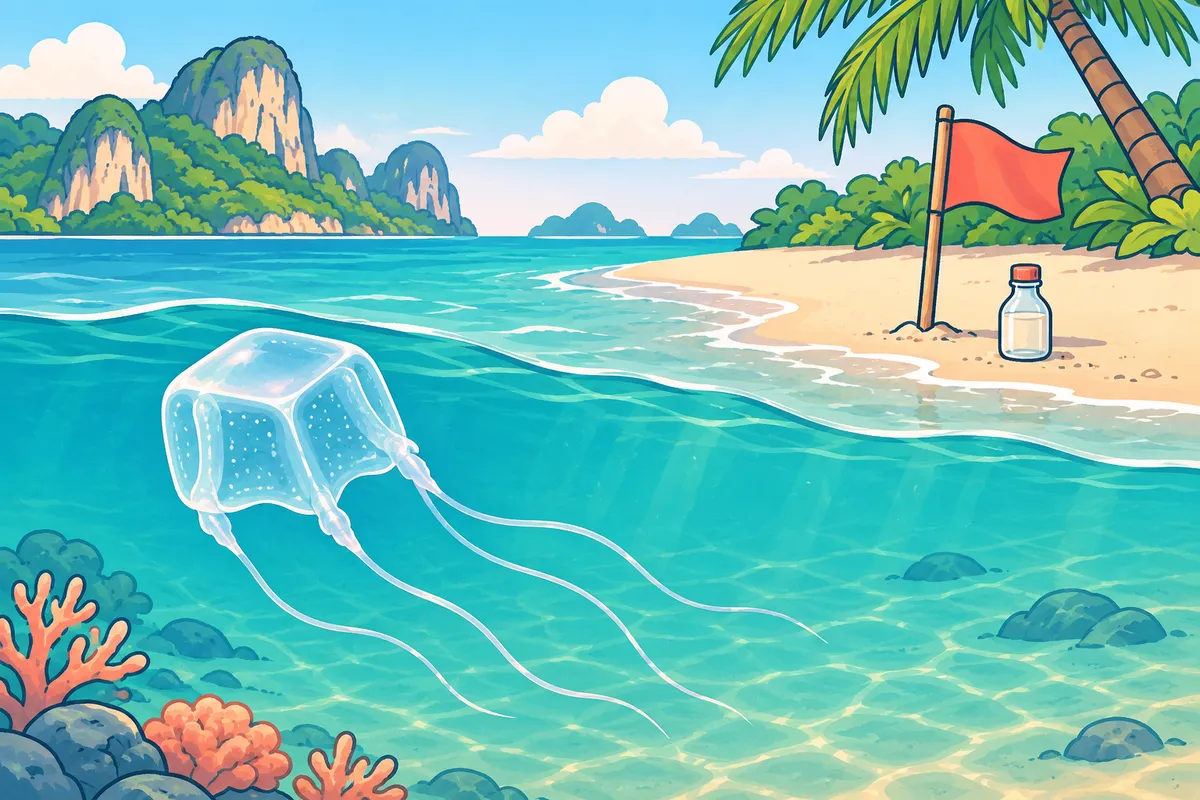
What a box jellyfish is, and why it is hard to see
A box jellyfish (class Cubozoa) is named after its bell, which is shaped like a rounded cube. Unlike a drifting moon jelly it swims actively, has eyes (six in each of four sensory clusters) and hunts small fish and prawns. The bell is clear and faintly bluish, so in shallow, sunlit water it is nearly invisible. That is the central problem for swimmers: there is no warning shape on the surface, and the animals tend to appear on calm days in sandy shallows away from reefs, often towards evening.
Thai waters hold several kinds, and from the beach you cannot tell them apart:
- **Chironex (Chironex indrasaksajiae)**: the multi-tentacled species described from the Gulf of Thailand and formally named only in 2017. Each corner of the bell carries a fleshy arm with a bundle of up to 12 ribbon-like tentacles. It is the species behind most deaths.
- **Chiropsoides (Chiropsoides buitendijki)**: the most commonly found multi-tentacled box jellyfish; the sting is usually milder but still very painful, and it looks almost the same as Chironex.
- **Morbakka**: one flat tentacle in each corner. It is the main suspect in Thailand's cases of Irukandji-like syndrome, where serious symptoms arrive after a delay.
- **Tripedalia**: tiny, fingernail-sized box jellyfish of mangroves and sheltered bays; the sting is usually mild.
Our species guide has a page for each of them, with drawings and sting symptoms.
How dangerous it really is: the numbers
Official statistics are the best way to keep this in proportion. Thailand's Department of Disease Control counted 10 deaths and 36 severe injuries from box jellyfish between fiscal years 1999 and 2022, spread over eight provinces: Trat, Rayong, Phetchaburi, Chumphon, Surat Thani, Phuket, Krabi and Satun. Over more than two decades, set against the number of people who swim in Thai waters every year, that is a small number. It is also not zero, and the severe cases are heavily concentrated.
A case series from Koh Samui and Koh Phangan looked at 15 box jellyfish cases on the two islands. Six were fatal (46.7%). The median age was 26 years, ranging from 5 to 45, and 60% of the patients were women. More than half were unconscious. Almost all involved the multi-tentacled family Chirodropidae. The authors concluded that Samui and Phangan have the highest incidence of fatal and near-fatal box jellyfish cases in Thailand. The skin marks they describe look like caterpillar tracks or step-ladder burns, which is also how doctors recognise a box jellyfish sting after the fact.
In that series, only one of the six fatal cases had vinegar applied to the wounds. Among six survivors with known first aid, half received vinegar. One fatal case had fresh water and ice packs applied instead.
That detail is the practical lesson of the whole data set: the difference between a frightening afternoon and a tragedy often comes down to what is done in the first minute. For the lighter, delayed form of the syndrome, doctors in Thailand documented 19 cases of Irukandji-like syndrome between 2007 and 2019. Where the animal could be identified it was Morbakka, and every patient in that study had high blood pressure.
Where and when: Gulf islands first, Andaman too
The Department of Marine and Coastal Resources (DMCR) publishes a yearly status report on toxic jellyfish. According to that report, the most severe cases happen on Koh Samui and Koh Phangan from July to November, around Koh Mak and Koh Kood from December to March, and on Koh Lanta from March to June. On 3 August 2026 DMCR also reported a death on a beach in Sichon district, Nakhon Si Thammarat, suspected but not confirmed to be a box jellyfish sting, noting that box jellyfish are recorded in that part of the lower Gulf every year between August and December.
| Area | Coast | Main reported period | Note |
|---|---|---|---|
| Koh Samui, Koh Phangan | Gulf | July to November | Highest number of fatal and near-fatal cases; vinegar posts on beaches |
| Koh Tao and the rest of Surat Thani | Gulf | Same Gulf pattern, fewer reports | Treat as the same risk, check locally |
| Koh Mak, Koh Kood (Trat) | Gulf | December to March | Eastern Gulf; vinegar posts |
| Lower Gulf (Nakhon Si Thammarat, Songkhla) | Gulf | August to December | DMCR note from August 2026 |
| Koh Lanta (Krabi) | Andaman | March to June | Andaman cases are fewer but documented |
| Phuket, Krabi, Satun | Andaman | Year-round records of smaller species | Chiropsoides and Morbakka occur on this coast |
Two cautions about this table. First, DMCR itself notes that its seasonal picture is imperfect: survey frequency changed from year to year, September to October data are patchy because of the budget year, and survey stations are mostly on the main tourist beaches. Second, "peak season" is not "safe off-season". Chiropsoides and Morbakka are recorded almost year-round, and our season page shows official warnings by month for both coasts.
For a specific beach, start from the area pages: Koh Samui, Koh Phangan, Koh Tao, Phuket and Krabi. Each shows the current forecast and recent reports.
What a sting looks and feels like
The first sign is sudden, burning pain, often described as a whip or an electric shock. Red-purple welts appear within seconds, in long, tangled lines with a ladder-like cross-hatching. With a large sting the person may lose consciousness, stop breathing or go into cardiac arrest within minutes. Morbakka is different: the local pain may be moderate, but 5 to 40 minutes later there can be severe back and muscle pain, a racing heart, high blood pressure, nausea, sweating and panic. A panicking person can drown, which is why anyone stung should leave the water immediately and be watched even if they feel better.
Our page on what stings look like has photographs and illustrations so you can compare.
First aid: the steps that matter
- Get the person out of the water and shout for lifeguards or anyone nearby. Do not enter deep water yourself without a way to get back.
- If they are not breathing or are unresponsive, call 1669 (national emergency medical service) and start CPR straight away. Cardiac arrest is the main cause of death.
- Pour household vinegar over every stung area for at least 30 seconds. Australian guidelines recommend vinegar for suspected box jellyfish and Irukandji-type stings. Many Thai beaches have vinegar stations at lifeguard towers; know where yours is.
- After the vinegar, lift off remaining tentacles with tweezers or a gloved hand. Keep rinsing your own fingers afterwards.
- Do not rub, do not rinse with fresh water, and do not use alcohol, urine or sand. Do not apply ice directly to the skin or a pressure bandage.
- Go to hospital for any suspected box jellyfish sting, even if the person looks fine, and especially for children, a sting over a large area, or sting to the face. Symptoms of the Irukandji-like form can start late.
If no vinegar is within reach, do not lose time: calling for help and starting CPR if needed matter more than the choice of liquid. See the full first-aid page, and consider packing a small bottle of vinegar in your beach first-aid kit.
How to lower your risk without giving up the beach
- Swim where lifeguards are on duty and a vinegar station is in sight, and ask them: "Any jellyfish today?" See beach flags in Thailand for flags and lifeguard hours.
- Check the forecast for your beach and the latest reports on this site before you go in, especially on Samui and Phangan between July and November.
- Be most careful on calm days, in sandy shallows and towards evening, the conditions DMCR describes for the larger species.
- Keep children out of the water on beaches with a recent warning. They get a larger dose per kilogram of body weight.
- Wear a full-body lycra suit in high-risk areas and seasons. See our guide to stinger suits and rash guards for what protects and what does not.
- If someone reports a sting at your beach, leave the water. One sting is a signal that the animals are in the bay.
You cannot see box jellyfish reliably. Plan around the season, the lifeguards, the forecast and the vinegar bottle, not around your eyesight.
Questions and answers
Are there box jellyfish in Phuket?
Yes, smaller box jellyfish species such as Chiropsoides and Morbakka are recorded on the Andaman coast including Phuket, but the severe and fatal cases in Thailand are concentrated on Koh Samui and Koh Phangan in the Gulf of Thailand.
When is box jellyfish season in Koh Samui?
DMCR places the most severe cases on Koh Samui and Koh Phangan between July and November. Smaller species occur almost year-round, so the risk never drops to exactly zero.
Can a box jellyfish sting kill you?
It can. Thailand recorded 10 deaths and 36 severe injuries from box jellyfish between fiscal years 1999 and 2022, according to the Department of Disease Control. Most stings are far milder, and fast vinegar treatment plus emergency care greatly improves the outlook.
Should I use vinegar or hot water on a box jellyfish sting?
Vinegar first, for at least 30 seconds, because it stops further venom release from stinging cells still on the skin. Hot water is used for pain relief afterwards for some other jellyfish; for a suspected box jellyfish the priority is vinegar, emergency help and hospital.
How can I tell if it was a box jellyfish?
Look for long, whip-like or ladder-patterned welts, severe immediate pain, or symptoms that start 5 to 40 minutes later, such as back pain, racing heart and anxiety. If you are not sure, treat it as a box jellyfish sting.