



Stinger suits and rash guards for jellyfish in Thailand: what actually protects you
A stinger suit is the only piece of gear that physically keeps jellyfish tentacles off your skin. It does not make you immune and it is not needed on every beach, but it is the most sensible layer on the days and beaches where the risk is real.
Why clothing works at all
A jellyfish sting happens when a stinging cell on a tentacle touches bare skin and fires. The cells are microscopic, and a tentacle that brushes a fabric barrier has a much harder time reaching you than one brushing your arm or leg. That is the entire principle behind a stinger suit: a thin, tight layer of stretchy fabric between you and the animal.
Stinger suits were developed in tropical Australia, where box jellyfish and Irukandji stings put people in hospital every year. A scientific comparison of eight types of protective clothing notes that marine stingers hospitalise roughly 100 people a year in tropical Australian waters and have caused at least 73 deaths, and that lycra body suits have been used for stinger protection since the early 1980s. The authors tested eight kinds of clothing against the tentacles of an Irukandji jellyfish. Their conclusion: lycra is vulnerable to the crushing of tentacles through the fabric, but appears to be the best choice for routine-use stinger-protective clothing.
Two things follow from that sentence. Lycra is a good default, so you do not need a thick neoprene wetsuit in Thai water that is around 30 degrees. And a suit is not armour: a tentacle pressed hard against the fabric, for example when you squeeze through it or when a loose suit is pushed against your skin, can still get through. Fit matters.
When it is worth wearing one in Thailand
Most days on most Thai beaches, a stinger suit is overkill. It makes sense when the specific danger is box jellyfish or Irukandji-type species, because those are the stings that can be life-threatening.
| Situation | Suit? | Why |
|---|---|---|
| Koh Samui or Koh Phangan, July to November, swimming or snorkelling | Yes, strongly advised | DMCR places the [most severe box jellyfish cases](https://warning.dmcr.go.th/th/knowledge/detail/19823) here in this window |
| Koh Mak and Koh Kood, December to March | Recommended | Seasonal box jellyfish reports in the eastern Gulf |
| Any beach with a recent box jellyfish warning | Yes, or do not swim | A warning means the animals are in that bay |
| Phuket and the Andaman coast in monsoon | Optional; useful for children | The usual problem is bluebottles, which sting through bare skin; a suit helps against stranded tentacles in the surf too |
| Calm dry-season swimming with no warnings | Optional | Risk is lower; a rash guard also helps with sun |
| Snorkelling or kayaking, where you are in the water for hours | Recommended | More skin exposure and more time in the water |
Check the beach forecast and recent reports before you decide. The forecast pages for Koh Samui, Koh Phangan and Phuket combine season, wind, waves and reports. Our guide to the Gulf island seasons shows the months at a glance.
What to wear, piece by piece
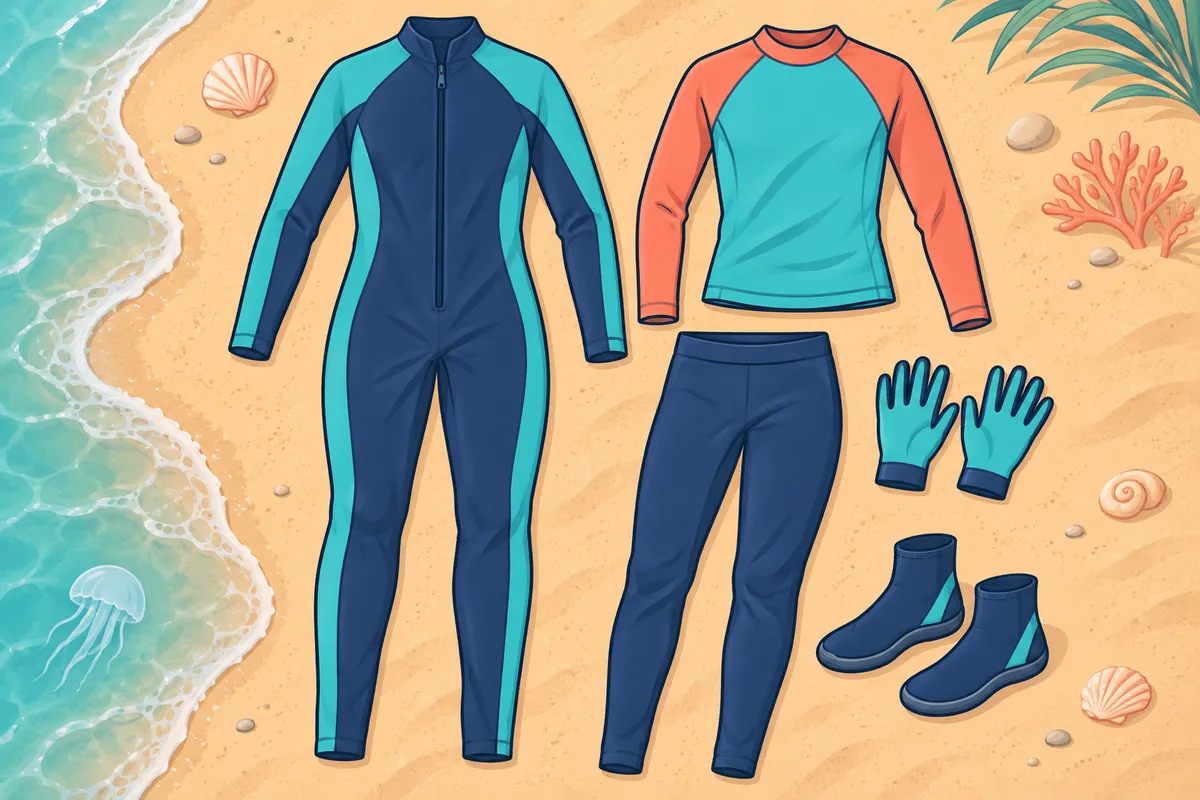
- **Full-body stinger suit (best):** a one-piece suit covering arms and legs, made from lycra or nylon-spandex, with a snug fit. It covers the large areas where most stings happen.
- **Rash guard plus leggings (good):** long sleeves and long leggings are a reasonable two-piece version. The gap at the waist is the weak point, so choose a rash guard that is long enough to overlap.
- **Hands, feet and face (the gaps):** thin swim gloves and neoprene booties close the biggest gaps. Hoods and face coverings exist in some stinger suits; if you do not use one, remember that stings to the face and neck are an emergency.
- **Fit:** tight but comfortable. Loose, baggy fabric lets tentacles tangle in the folds and press against skin.
- **Colour:** the fabric is not where jellyfish identify you, so choose any colour you like. Prefer a lighter colour in direct sun to stay cooler.
- **Ordinary clothes:** a T-shirt and shorts are not designed or tested for this and leave arms and legs partly exposed. They are better than bare skin for sun but should not be relied on for jellyfish.
Dive shops and sports retailers in the main tourist areas are the likeliest places to find or rent a suit so ask there first. If you are travelling with children, bring one from home in the right size.
What a suit does not do
- It does not protect your face, hands and feet unless you cover them.
- It does not stop crushing: a tentacle trapped between a tight suit and your skin can sting through thin fabric.
- It does not remove the need to treat a sting. If a tentacle touches you anyway, follow first aid: vinegar for suspected box jellyfish, call 1669 and go to hospital if the sting is large or you feel unwell.
- It does not make a beach with a box jellyfish warning safe. Stay out when there is a warning.
There is also a category of sting-inhibiting lotions that claim to reduce the chance of being stung. One has been tested in a randomised field trial, and such products may add a thin layer of protection to skin that a suit leaves bare, for example on the face. Treat them as a supplement, not a replacement for a suit, and do not expect them to work against a large box jellyfish sting.
Think of a stinger suit as one layer of four: the forecast, the lifeguards, the suit, and the vinegar bottle on the beach.
Putting it into practice
- Choose beaches with lifeguards and a vinegar station, and ask: "Any jellyfish today?"
- On Samui and Phangan between July and November, wear a full-body suit when you swim or snorkel, and keep children close to shore.
- Do not swim at night or at dusk on beaches with box jellyfish warnings; the larger box jellyfish are typically found on calm days in sandy shallows, often towards evening.
- Carry vinegar and tweezers: see the beach first-aid kit guide.
- Learn the first-aid steps before you go: the first-aid page and the comparison of urine, vinegar and hot water.
- Know what a serious sting looks like: sting photographs and illustrations.
Questions and answers
Do stinger suits protect against jellyfish in Thailand?
They reduce the chance of stings on the skin they cover. Testing of eight types of protective clothing found lycra the best choice for routine use, though tentacles can still be crushed through the fabric. Hands, feet and face remain exposed unless covered.
Do I need a stinger suit in Phuket?
Not usually. The common problems there are bluebottles in the monsoon months and stinging blooms in the dry season. A suit is optional but useful, especially for children and long snorkel trips.
Do I need a stinger suit on Koh Samui or Koh Phangan?
It is strongly advisable when swimming or snorkelling between July and November, when the most severe box jellyfish cases have been recorded on these islands.
Is a rash guard enough against jellyfish?
A long-sleeved rash guard with long leggings is a reasonable partial solution. A full-body suit is better because it removes gaps, and hands, feet and face still need attention.
Can jellyfish sting through a wetsuit?
A neoprene wetsuit adds more material, but in Thai water temperatures most people find it too hot, which is why thin lycra is the usual choice. No clothing makes you immune, so keep vinegar and first-aid knowledge handy.