



Does peeing on a jellyfish sting work? What to do instead in Thailand
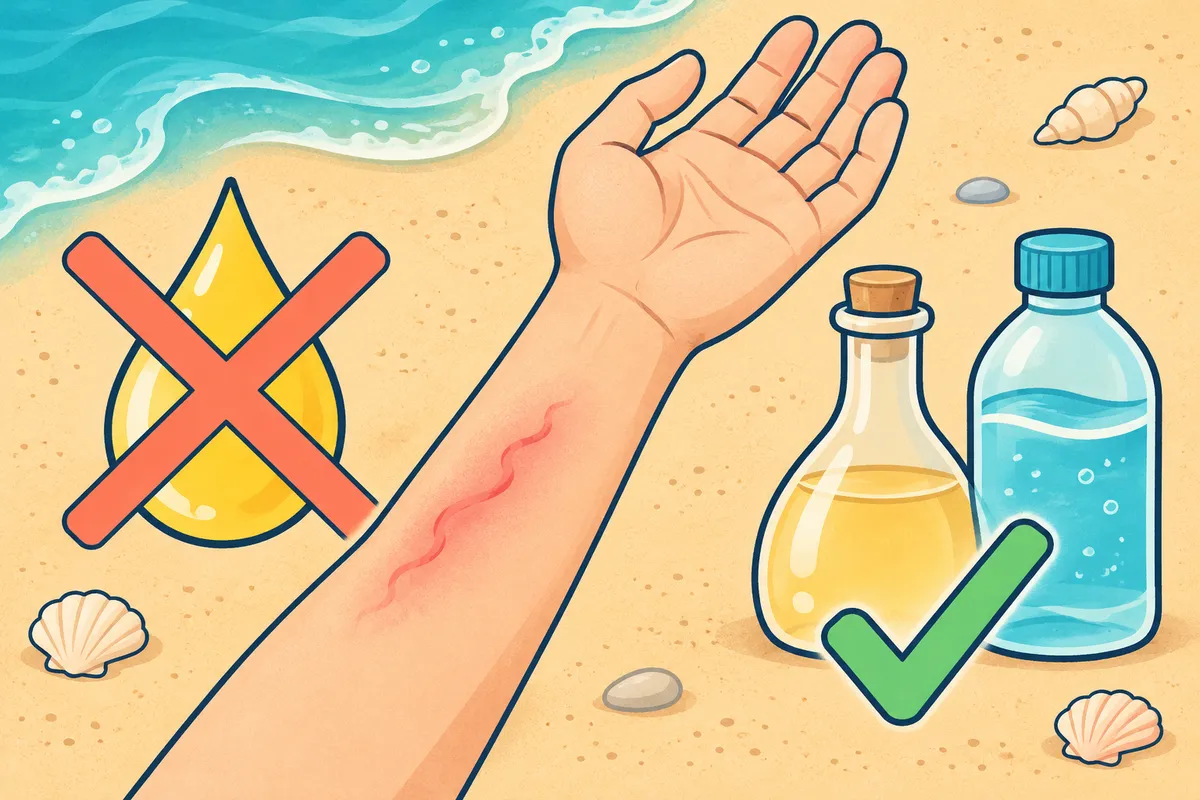
Everybody has heard it: if a jellyfish stings you, someone should pee on it. It is a myth with a long life, and the evidence and first-aid guidelines say it does not help. Here is what does, depending on which animal stung you.
Where the myth comes from, and why it does not work
The idea is that urine is acidic or contains ammonia, so it will "neutralise" venom. A jellyfish sting is not an acid or a base that can be neutralised in this way. The venom is injected into the skin by thousands of microscopic stinging capsules called nematocysts, and what counts in first aid is stopping more capsules from firing and easing the pain. Urine is a variable mix of water, salts and waste products. Its composition depends on how much the person has drunk, and it is not sterile in any practical sense.
There is a second, more serious problem. Stinging capsules can discharge when the chemistry around them changes. Fresh water, which is what urine mostly is, is a known trigger for some species because it changes the salt balance around the capsules. That is why guidelines say not to wash a sting with fresh water, and why medical sources such as the Cleveland Clinic call peeing on a sting a myth. A review of European jellyfish stings found evidence that oral analgesics, seawater, a baking-soda slurry and hot water of 42 to 45 degrees help, and that vinegar for 30 seconds helps for specific species. Urine did not make that list.
To be fair to the science: there is no good trial that has put real urine on real stings in volunteers, because nobody has a reason to run one. The honest summary is that urine has no proven benefit, has plausible mechanisms for harm, and is a bad use of the first minute after a sting.
What helps depends on the animal
This is the part most articles skip. A jellyfish sting is not one problem. In Thailand you meet at least four different ones, and the first-aid advice differs between them. The Cochrane review of jellyfish sting treatments (2023) says it plainly: the certainty of the evidence is low or very low for most treatments, and the data we do have support some measures, such as hot water and, only for box jellyfish and non-Australian bluebottles, vinegar. A 2025 systematic review of first aid reached a similar conclusion and suggests seawater as the default rinse, simply because it is free and everywhere on a beach.
| Sting | First step | For pain | Avoid |
|---|---|---|---|
| Suspected box jellyfish (long welts, severe pain, ladder-like marks) | Get out of the water, call 1669, pour vinegar for 30 seconds or more, lift off tentacles | After the emergency is handled, heat or cold packs per medical advice | Fresh water, rubbing, ice directly on skin, pressure bandages, urine |
| Bluebottle / Portuguese man o' war (blue float, thin red beaded lines) | Rinse with seawater, pick off tentacles with tweezers or a card | Hot water, as hot as is comfortable (about 45 °C) for 20 to 30 minutes; cold pack in cloth if no hot water | Fresh water, rubbing, urine |
| Other jellyfish (sea nettle, lion's mane, rhizostomes) | Rinse with seawater, remove tentacles | Hot water if available, or cold pack in cloth; paracetamol/ibuprofen if medically suitable | Fresh water, scratching, urine |
| Not sure what it was | Treat as box jellyfish: vinegar, then reassess | As above once symptoms are clear | Fresh water, urine |
Why does this protocol vary? ANZCOR guideline 9.4.5, the Australian and New Zealand resuscitation guideline, recommends vinegar only for stings that may be due to box jellyfish and Irukandji-type species, and says not to use it for bluebottle stings. Hot water of about 45 °C is described as a measure supported by several studies, though the guideline notes a theoretical risk that heat could increase venom absorption; for suspected box jellyfish the priority is vinegar and emergency care. The UK NHS takes the most practical position for northern waters: rinse with seawater, remove spines or tentacles with tweezers or a bank card edge, and soak in very warm water for at least 30 minutes.
What this means on a Thai beach
Thailand is not Australia or the UK. Several species in the same bay can sting you, and the one that can kill you is the box jellyfish. That tilts the decision:
- **Use vinegar first if you do not know what stung you.** It is the best-supported step for box jellyfish, and in Thailand a case series of 15 severe cases on Samui and Phangan found vinegar had been used in only one of six fatal cases, while fresh water and ice had been used in one. Vinegar stations at lifeguard towers exist for this reason.
- **Call 1669 if the sting is large, on the face, on a child, or followed by breathlessness, chest pain, confusion, severe back pain or vomiting.** These can appear 5 to 40 minutes after the sting with Irukandji-like species.
- **If it was clearly a bluebottle**, rinse with seawater, remove tentacles and use hot water for pain. Vinegar is not harmful in the sense that matters on the beach, and our own first-aid page recommends it when you cannot tell what stung you.
- **For mild stings from sea nettles, moon jellies or hairy jellyfish,** seawater, tweezers or a card, and hot water or a cold pack usually do the job.
Vinegar and seawater are the first steps. Fresh water, ice on bare skin, rubbing, alcohol, sand and urine are the steps to skip.
Other popular remedies, quickly
- **Baking soda paste:** a baking-soda slurry appears in the European review as effective against nematocyst discharge for some species. It is a reasonable second line for mild stings, but not a replacement for vinegar on a suspected box jellyfish.
- **Hot water:** moderate evidence of pain relief across several jellyfish. Test the temperature on unaffected skin first so you do not scald the patient, who may have reduced sensation.
- **Ice:** only wrapped in cloth, only for pain; ice directly on the skin can damage it.
- **Meat tenderiser, alcohol, toothpaste, shaving foam:** each shows up in folklore. None is recommended by guidelines, and alcohol and some other substances can trigger stinging cells.
- **Scraping the skin with a card:** acceptable after you have inactivated tentacles with vinegar or seawater. Scraping first can squeeze remaining capsules.
- **Sting-inhibiting lotions:** some products claim to reduce stings when applied before swimming. Treat them as an extra layer at best; a full-body lycra suit is a more reliable barrier. See stinger suits and rash guards.
After any sting, watch for signs of allergy (swelling of the face or lips, a spreading rash, wheezing) and later for infection (spreading redness, pus, fever). Skin marks from box jellyfish can scar, and a doctor can advise on care.
Get ready before you need it
The best time to learn first aid is on the hotel balcony, not on the sand in the first minute. Save 1669 in your phone, find out where the vinegar station is on your beach, pack a small bottle of household vinegar and tweezers, and read the full jellyfish first-aid page. Our guide to a beach first-aid kit lists what to pack, and the page on what stings look like helps you recognise a serious sting. If you want to avoid the sting in the first place, check the forecast for your beach before you go in.
Questions and answers
Does peeing on a jellyfish sting help?
No. No first-aid guideline recommends it, there is no evidence of benefit, and any liquid that is mostly fresh water can make some stinging cells release more venom. Use vinegar for suspected box jellyfish or seawater for other stings.
Should I use vinegar or hot water on a jellyfish sting?
It depends on the animal. For suspected box jellyfish, vinegar for at least 30 seconds is the first step and you should call 1669. For a bluebottle or most other jellyfish, rinse with seawater and use hot water (about 45 °C) for pain.
Can I wash a jellyfish sting with fresh water?
No. Fresh water can trigger stinging cells that are still on the skin. Rinse with seawater instead, or use vinegar if box jellyfish are possible.
What if I have no vinegar on the beach?
Do not lose time. Get out of the water, call for help, and if a severe box jellyfish sting is possible, call 1669 and start CPR if the person is not breathing. Rinse gently with seawater and remove tentacles with tweezers or a card.
Does ice help a jellyfish sting?
A cold pack wrapped in cloth can ease pain for some stings, but ice directly on skin should not be used, and ice is not a substitute for vinegar after a possible box jellyfish sting.