



Portuguese man o' war (bluebottle) in Thailand: where, when and what to do
The Portuguese man o' war, or bluebottle, is the jellyfish Thai lifeguards report most often. It cannot swim: the wind pushes it ashore, so it turns up on exposed beaches after a few days of onshore wind, and stranded ones keep stinging on the sand.
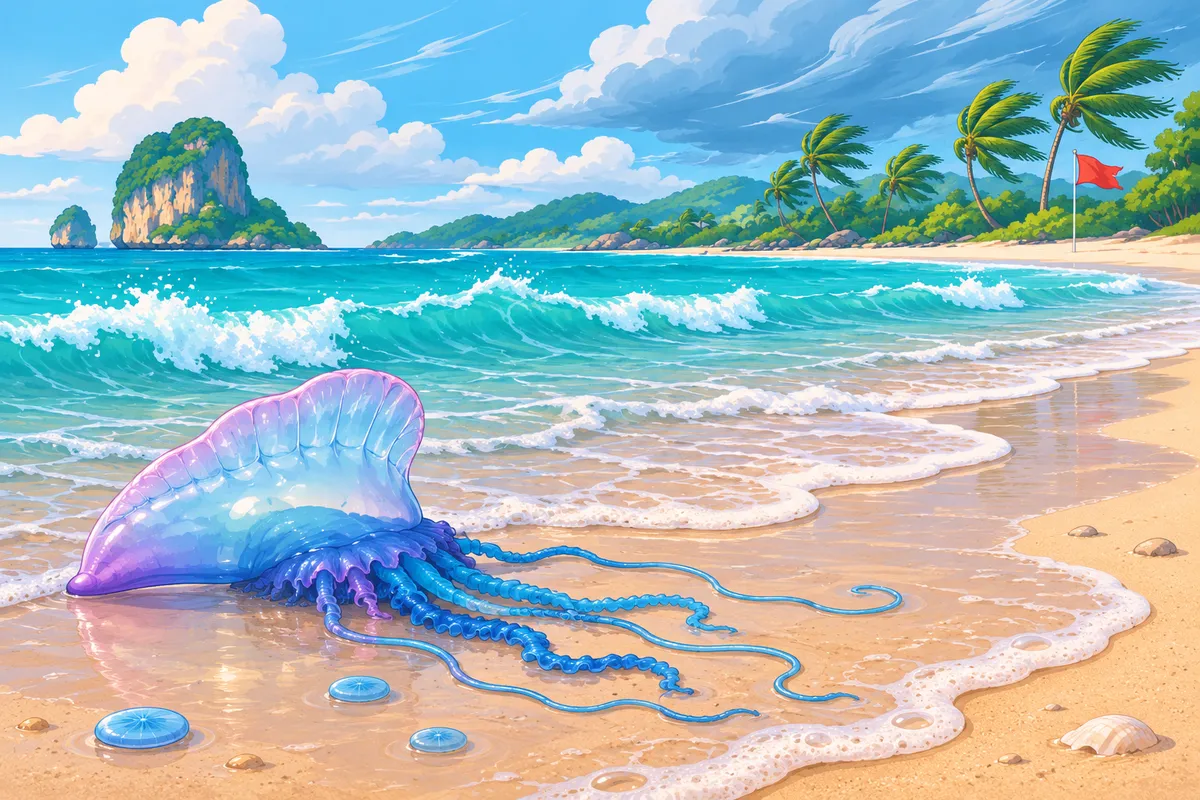
What a bluebottle is
A bluebottle (genus Physalia) is not a true jellyfish but a siphonophore: a floating colony of specialised animals. On top sits a gas-filled float, translucent blue to violet, with a low crest that works as a sail. Underneath hang blue feeding polyps and the stinging tentacles, which can be much longer than the float and often coil into spirals. Thai names include แมงกะพรุนหัวขวด, "bottle-head jellyfish".
Because it cannot swim, where a bluebottle ends up depends on the wind, the waves and the surface current. That makes bluebottles the most predictable stinger on Thai beaches: they come with onshore wind and leave when it stops. It also means you can see them coming. Our research article on forecasting bluebottles ten days ahead shows how wind and currents carry them to the coast.
Thai bluebottles are usually small. In DMCR surveys on Karon Beach in May 2026, floats measured about 2 to 5 centimetres, and the bluebottle that stung a tourist at Nai Thon in September 2026 had a float of about 3 centimetres. Small does not mean harmless: the tentacles are what sting. See the bluebottle profile for photos.
Where and when: what DMCR warnings show
Thailand's Department of Marine and Coastal Resources (DMCR) publishes a list of jellyfish warnings after stings, strandings or blooms are reported. Of the 47 entries from January 2024 to September 2026, 18 name bluebottles. That is more than any other group, and it reflects both how often bluebottles strand and how easy their blue floats are to spot and report.
| Where | Warnings | When |
|---|---|---|
| Phuket west coast: Karon, Kata, Karon Noi, Mai Khao, Nai Thon | 11 | June 2024; July to September 2025; March, May, June and September 2026 |
| Koh Racha Yai (Patok Bay), south of Phuket | 2 | September 2025, May 2026 |
| Laem Phan Wa, east Phuket | 1 | June 2026 |
| Phang Nga: Bang Sak, Bang Lut (Takua Pa) | 2 | June 2026 |
| Songkhla: Samila Beach (Gulf) | 1 | February 2025 |
| Pattani: Talo Samilae (Gulf) | 1 | February 2026 |
Two seasons stand out. On the **Andaman coast**, bluebottles come with the south-west monsoon. Fifteen of the sixteen Andaman warnings fall between late May and September, with a cluster in the last days of May and the first half of June 2026, when DMCR recorded strandings at Karon, Patok Bay, Mai Khao, Bang Sak, Bang Lut and Laem Phan Wa within three weeks. On 28 May 2026 lifeguards at Karon reported bluebottles on the beach while waves were about 2 to 3 metres high. In the **southern Gulf**, both warnings came in February, during the north-east monsoon: at Samila Beach in Songkhla bluebottles stranded together with by-the-wind sailors, and at Talo Samilae in Pattani a survey counted 33 bluebottles along 200 metres of beach.
Bluebottle risk follows onshore wind. On the Andaman coast that means late May to September on west-facing beaches; on the southern Gulf coast, the north-east monsoon around February.
Other coasts are not immune. The season page shows warnings by month for each coast, and each beach page combines the season with the actual wind and waves for the next days. For Phuket specifically, read our Phuket guide; the beaches with the most bluebottle warnings are Karon and Kata.
Lookalikes on the same beach
Bluebottles rarely strand alone. On 29 May 2026 a DMCR survey at Karon counted about 2 bluebottles per 100 square metres of beach, alongside about 9 blue buttons, 9 by-the-wind sailors and 1 blue dragon per 100 square metres. All four are blue, all float, and all are brought in by the same wind.
- **Blue button (Porpita).** A flat round disc, a few centimetres across, with a fringe of short blue tentacles. No inflated float. Mild sting; still, do not handle. See the blue button profile.
- **By-the-wind sailor (Velella).** A flat oval raft with a thin, clear triangular sail standing on top. Very short tentacles, usually harmless to skin. See the by-the-wind sailor profile.
- **Blue dragon (Glaucus and Glaucilla).** A small blue sea slug with feathery arms. It eats bluebottles and stores their stinging cells, so it can sting too. Do not pick one up.
- **Plastic.** Blue bags and balloons are sometimes taken for bluebottles. If it has a crest and tentacles, it is the real thing.
If you see blue buttons and sailors on the tideline, assume bluebottles may be in the water too. The wind that brought one brought them all.
What a bluebottle sting feels and looks like
The sting is immediate: a sharp, burning pain, often described as an electric shock, that can spread up the arm or leg. The skin shows a line of small red or white beads and welts where the tentacle touched, like a string of pearls; the track is usually thinner and shorter than a box jellyfish's. Compare photos on our page about what a sting looks like.
Pain usually peaks in the first minutes and fades over an hour or two; the marks often go within a day or two. Healthdirect Australia notes that bad stings can blister and need dressings, and that very rarely, in fewer than 1 in 100 people stung, a bluebottle causes nausea, vomiting, belly or muscle pain, or breathing problems. Children, people with allergies and people stung over a large area are more likely to react strongly.
One DMCR record shows what a typical Thai case looks like. On 9 September 2026 a foreign tourist of about 23 was stung at Nai Thon Beach, Phuket; when DMCR staff arrived, red flags were up for strong waves. Lifeguards identified a single bluebottle with a 3 centimetre float, gave first aid and took her to hospital with burning pain.
First aid for a bluebottle sting
- Get out of the water. Do not rub the skin, and do not rinse with fresh water.
- Pick off any tentacles with tweezers, a gloved hand or the edge of a card, and rinse the skin with seawater.
- Put the stung area in hot water, as hot as you can comfortably stand without scalding, about 43 to 45 °C, for 20 minutes or longer. Healthdirect advises about 45 °C for 20 minutes; Mayo Clinic says 43 to 45 °C until the pain eases, which may take 20 to 45 minutes. A hot shower works. Test the water on unstung skin first, especially for children.
- No hot water? A cold pack wrapped in cloth helps with pain.
- Later, a 0.5 to 1% hydrocortisone cream and an antihistamine tablet can ease itch; Thai pharmacies sell both.
- Call 1669 for breathing trouble, chest pain, fainting, a large area stung, or a stung child.
**About vinegar.** Australian guidelines (ANZCOR, Healthdirect) advise against vinegar for bluebottle stings, because it can make some bluebottle stinging cells fire. DMCR advisories in Thailand, including those for Karon and Bang Sak in June 2026, tell people to pour vinegar on any jellyfish sting for at least 30 seconds and go to hospital. Both make sense in context: in Thailand you often cannot be sure what stung you, and box jellyfish live on the same coasts. Our rule: if you saw the blue float and are sure it was a bluebottle, use seawater and hot water; if you are not sure, use vinegar as for a box jellyfish. The urine, vinegar and hot water comparison goes through the evidence.
How to avoid bluebottles
- Check the beach forecast. After two or three days of steady onshore wind, risk on exposed beaches goes up.
- Walk the tideline before you swim. Blue floats, discs or sails on the sand are your warning.
- Never touch a stranded bluebottle, and stop children from poking them with sticks; the tentacles stay active after death and can tangle around a stick or a toy.
- In the monsoon, red flags for waves often coincide with bluebottle days. Read what the flags mean.
- A long-sleeved lycra suit protects covered skin. The stinger suit guide compares options.
- Saw bluebottles? Report them. A sighting feeds the forecast for nearby beaches along the drift path.
Questions and answers
Are there Portuguese man o' war in Thailand?
Yes. Bluebottles (Physalia) are the jellyfish named most often in Thai marine department warnings: 18 of 47 from January 2024 to September 2026, mostly on Phuket's west coast and the Phang Nga coast.
When is bluebottle season in Thailand?
On the Andaman coast from late May to September, when the south-west monsoon blows onshore. On the southern Gulf coast (Songkhla, Pattani) warnings have come in February, during the north-east monsoon.
Can a dead bluebottle on the beach sting?
Yes. The stinging cells in the tentacles keep working after the animal strands and dries out. Do not touch it, and keep children away.
What helps a bluebottle sting?
Remove tentacles, rinse with seawater and soak the area in hot water at about 43 to 45 °C for at least 20 minutes. If you are not sure it was a bluebottle, pour vinegar over the sting first, as for a box jellyfish.
Is a bluebottle sting dangerous?
It is very painful but rarely dangerous. Fewer than 1 in 100 people stung develop whole-body symptoms such as vomiting or breathing problems. Call 1669 if that happens, or if a child or a large area is stung.
How long does a bluebottle sting last?
Pain usually fades within an hour or two with hot water, and the red marks within a day or two. Itching can last longer, and blisters may form after a bad sting.