



Jellyfish sting symptoms: what is normal, how it heals and when to see a doctor
Most jellyfish stings follow a predictable course: sharp pain at once, red marks within minutes, itch for a few days, and healed skin within a week or two. Knowing that course makes it easier to spot the stings that do not follow it, and those are the ones that need a doctor.
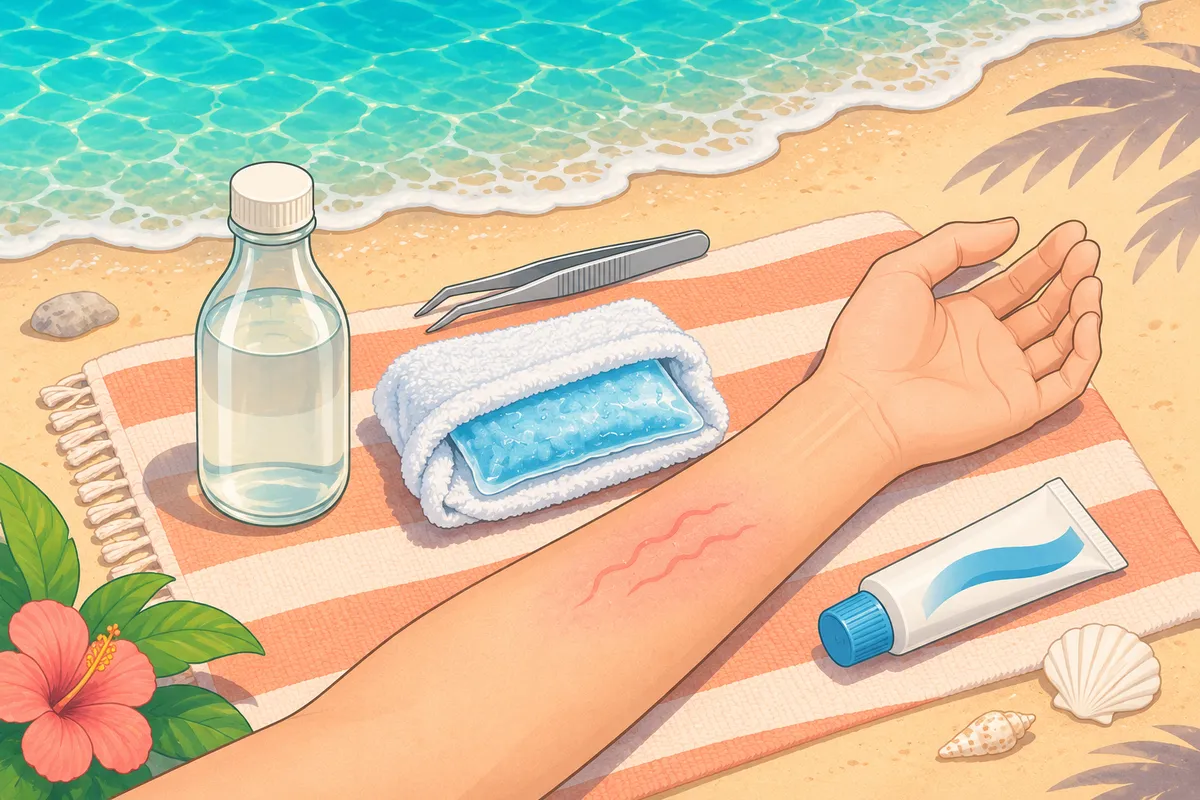
The first minutes
Jellyfish tentacles are lined with stinging cells, each holding a coiled thread that fires into the skin on contact and injects venom. That happens in a fraction of a second, so the pain is immediate. A published case review describes the typical local reaction: intense burning pain that is felt at once and peaks within about five minutes, followed by red welts, swelling and redness.
Mayo Clinic lists the usual symptoms as:
- burning, prickling, stinging pain;
- welts or tracks on the skin, a "print" of where the tentacles touched;
- itching;
- swelling;
- throbbing pain that spreads up an arm or a leg.
The shape of the mark often tells you what stung you, and that changes the first aid. Long whip-like welts with a ladder pattern suggest a box jellyfish; a chain of small red beads suggests a bluebottle; a patchy rash of small bumps is typical of mild species. Our page on what a sting looks like has photos of each. If you are not sure, treat it as a box jellyfish: vinegar for at least 30 seconds, then the steps on the first-aid page.
Warning signs: when a sting is an emergency
How bad a sting gets depends on the kind and size of the jellyfish, how long the tentacles stayed on the skin, how much skin was touched, and the person: Mayo Clinic notes that severe reactions are more likely in children. Severe stings can affect the whole body, and the symptoms may appear quickly or several hours later.
Call 1669 (Thailand's emergency medical number) or go to hospital at once for: difficulty breathing, chest pain, a racing or irregular heart, confusion, fainting or collapse; a sting covering a large area, such as more than half an arm or leg; any sting on the face, eye or genitals; a stung child; or signs of allergy such as hives all over, swelling of the lips or face, or wheezing.
**Irukandji syndrome.** Some small box jellyfish leave only a faint mark but cause a delayed whole-body reaction. Healthdirect Australia describes it starting 20 to 30 minutes after the sting, with severe pain in the back, belly, chest and muscles, a fast heart rate, high blood pressure, anxiety and agitation, nausea and vomiting; StatPearls gives a range of about 5 to 120 minutes, usually within the first 30. Cases with this picture have been described in Thailand too. If a sting that seemed minor is followed by this kind of pain, go to hospital even if the skin looks fine.
For a box jellyfish sting, see a doctor even if you feel better: our box jellyfish guide explains why Thai doctors take these stings seriously.
The first hours
With first aid, pain from most stings settles over the next one to a few hours. The red lines may darken, swell into raised welts or turn into small bumps. Itching usually takes over as the pain fades. That is the normal course.
- **Mild species and fire jellyfish:** burning and redness for an hour or two, then itch; the rash often fades within hours to a day.
- **Bluebottle:** sharp pain that eases over an hour or two, faster with hot water; marks usually fade within a day or two. Bad stings can blister. See our bluebottle guide.
- **Box jellyfish:** severe pain from the start, long welts that can blister within hours and last for days or longer. Always medical care.
Things that make the first hours worse: rubbing the skin, rinsing with fresh water, scrubbing with sand, alcohol and urine. Our article on urine, vinegar and hot water explains what each one does.
Days 1 to 7: how a sting heals
Mayo Clinic notes that most stings get better over a few days or weeks with home treatment. During that time you can expect:
- **Itching**, often worse at night and in the heat. A cold pack wrapped in cloth helps.
- **Red or brown lines** where the tentacles touched, fading slowly.
- **Small blisters** after stronger stings. Leave them intact and keep them clean and covered; healthdirect notes that blisters after bad bluebottle stings may need dressings.
- **Flaking or peeling** as the skin recovers, usually toward the end of the first week.
What helps: Mayo Clinic suggests a 0.5 to 1% hydrocortisone cream twice a day on the stung skin, and oral antihistamines can take the edge off the itch. Both are sold over the counter in Thai pharmacies; tell the pharmacist it is a jellyfish sting. Keep the area out of strong sun while it heals, and try not to scratch. Swimming in the sea is fine once the skin is closed and not blistered.
See a doctor during this stage if the pain is getting worse instead of better, the area becomes hot, more swollen or more painful, red streaks spread from it, it oozes pus, or you develop a fever. Those are signs of infection, which is more likely after scratching and blisters in a hot, humid climate.
A week or more later: delayed and recurrent reactions
A common worry is a sting that comes back. You are home, the marks have faded, and a week or two later an itchy red rash appears in exactly the same lines. This is a recognised delayed reaction, driven by the immune system rather than the venom itself. The case review cited above notes that skin lesions after jellyfish stings may appear hours late, persist for months, or recur without a new sting. Reports describe flare-ups from about one to four weeks after the original sting, often as small itchy bumps along the tentacle track.
- It is not a new sting and not an infection, and it is not contagious.
- It usually responds to steroid creams and antihistamines; Mayo Clinic notes that delayed rashes may need oral antihistamines or corticosteroids from a doctor.
- It can come back more than once before settling.
- See a doctor or dermatologist if it is widespread, very itchy or keeps returning, and mention the jellyfish sting and the date, since the link is easy to miss.
Marks and scars
Most stings heal without a trace. After stronger stings, especially box jellyfish stings and stings that blistered, the skin can keep a pattern of darker (or sometimes paler) lines for weeks or months. In the case report above, both patients still had post-inflammatory darkening of the skin four months after the sting. These marks usually fade slowly on their own; sun makes them darker and slower to fade, so cover them or use sunscreen.
Raised or indented scars are possible after deep box jellyfish stings and infected blisters. If a mark is still raised, hard or itchy after a few months, see a dermatologist: treatments work better early.
Timeline at a glance
| When | Normal | Get help |
|---|---|---|
| First minutes | Burning pain that peaks within about 5 minutes; red lines or welts | Breathing trouble, chest pain, collapse, a large sting, a child, face or eye |
| 20 to 30 minutes (up to about 2 hours) | Pain easing with first aid | Severe back, belly, chest or muscle pain, sweating, vomiting, racing heart: possible Irukandji syndrome |
| First hours | Pain turns into itch; marks may swell or darken | Pain getting worse, spreading swelling, signs of allergy |
| Days 1 to 7 | Itch, fading marks, small blisters, peeling | Heat, pus, red streaks, fever: possible infection |
| 1 to 4 weeks | An itchy rash may return in the same lines | Widespread or repeated flare-ups |
| Months | Dark or pale lines fading slowly | Raised, hard or itchy scars |
Getting help in Thailand
- Emergency medical number: **1669**. Tourist police: **1155**. Both work from any phone.
- Lifeguards on the main beaches often keep vinegar and know the local jellyfish; ask them first.
- Public and private hospitals on Phuket, Koh Samui, Koh Phangan, in Krabi and in Pattaya have emergency departments that see jellyfish stings.
- Take a photo of the sting and, if it is safe, of the jellyfish or the tentacles. It helps the doctor and helps us: report the sting so the forecast for that beach reflects it.
- If you have travel insurance, keep the receipts and the medical report for the claim.
To lower the chance of a sting in the first place, check the forecast for your beach, wear a lycra suit in the risky months (see the stinger suit guide) and pack a small beach first-aid kit.
Questions and answers
What are the symptoms of a jellyfish sting?
Burning, prickling pain at once; red lines, welts or a rash where the tentacles touched; itching and swelling; sometimes pain spreading up the limb. Severe stings can cause breathing trouble, chest pain, vomiting or collapse and need emergency care.
How long does a jellyfish sting take to heal?
Pain usually fades within hours, and most marks settle over a few days to two weeks. Stronger stings can leave darker lines for weeks or months.
Why is my jellyfish sting itchy again a week later?
A rash that returns one to four weeks after a sting, in the same lines, is a known delayed immune reaction. It is not a new sting or an infection, and it usually responds to steroid cream and antihistamines. See a doctor if it is widespread or keeps coming back.
When should I see a doctor after a jellyfish sting?
At once for breathing trouble, chest pain, fainting, a large sting, a stung child, a sting on the face or eye, signs of allergy, or severe body pain 20 to 30 minutes later. Later, for pain that gets worse, signs of infection, or a rash that keeps coming back.
Can a jellyfish sting leave a scar?
Most heal without a trace, but strong stings, especially from box jellyfish, can leave dark or pale lines for months, and occasionally raised scars. Keep the area out of the sun and see a dermatologist if a mark stays raised.