



Jellyfish in Pattaya, Jomtien and Koh Larn: season and what to expect
Pattaya is the one big Thai beach resort where the jellyfish season falls in the rainy months. When the south-west monsoon blows straight onto Pattaya Bay, Jomtien and the beaches of Koh Larn collect whatever floats in the upper Gulf, and most of what washes up is small and mild.
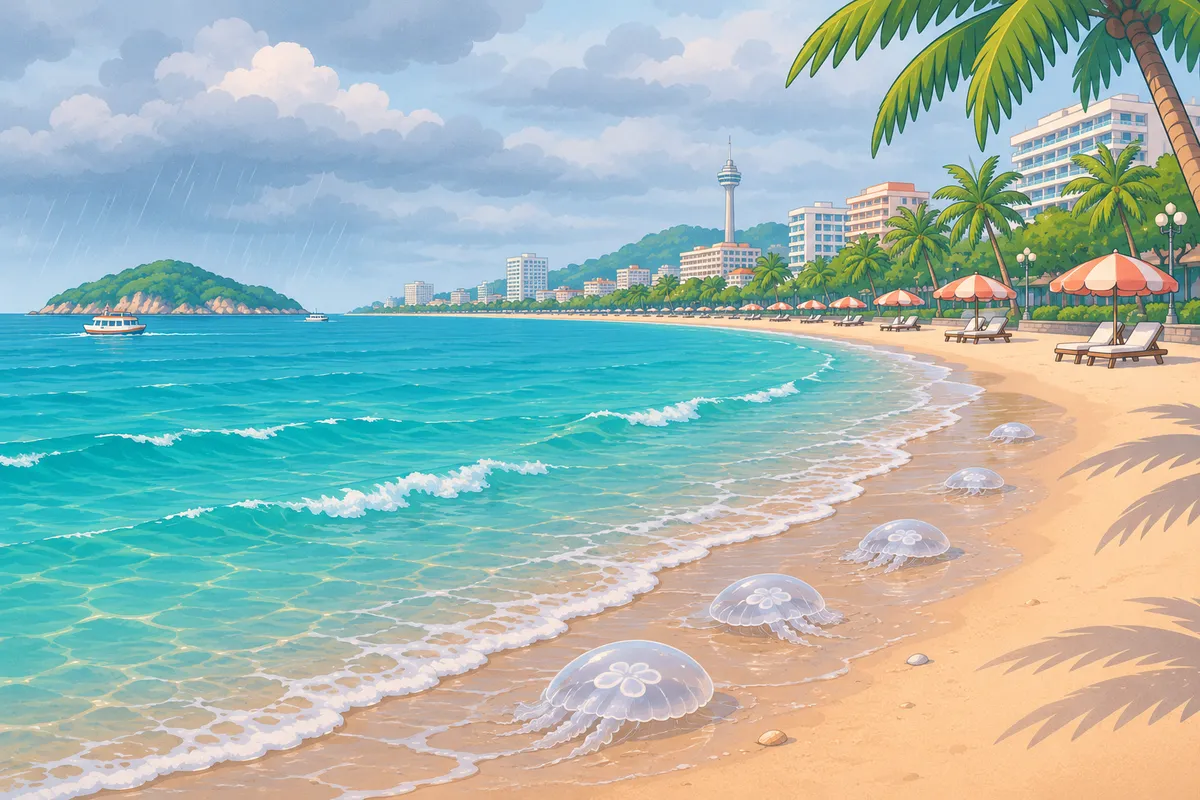
Why Pattaya's season is in the rainy months
Pattaya, Jomtien and Koh Larn sit on the eastern shore of the upper Gulf of Thailand, and their main beaches face west or south-west across the water. From about June to October the south-west monsoon blows from that direction. Anything drifting on the surface of the upper Gulf, from moon jellies to small stinging species, is pushed toward the shore and piles up on the beach and in the shallows.
From November to April the wind swings round to the north and east, blowing off the land, and the bay usually stays clear. That is the reverse of the islands on the other side of the Gulf, such as Koh Samui, and of Phuket on the Andaman coast, where the calm months bring their own jellyfish. If you have read about a "jellyfish season" in Thailand somewhere else, check which coast it was about.
| Months | Onshore wind | Days with high model risk | Jellyfish sightings reported |
|---|---|---|---|
| January | On 38% of days | 0% | 6 |
| February to March | On 38 to 43% of days | 3 to 8% | 25 to 26 per month |
| April to May | On 39 to 52% of days | 0% | 8 to 13 per month |
| June | On 90% of days | 33% | 72 |
| July | On 90% of days | 43% | 69 |
| August to September | On 81 to 89% of days | 4 to 6% | 55 to 79 per month |
| October | On 33% of days | 14% | 53 |
| November to December | On 23 to 28% of days | 0% | 5 to 11 per month |
The sightings column counts eyewitness reports from social media, beach reviews and users of this site across all years we hold. It tells you when people notice jellyfish, not how many there are, and Pattaya has a lot of people on the beach. Still, the shape is clear: June to October, with a smaller bump in February and March. The Pattaya page has the same calendar as a chart and today's forecast for each beach, and each month has its own page, for example Pattaya in July.
What washes up: mostly moon jellies and small clear jellyfish
The typical Pattaya jellyfish event is a beach covered in small, clear, jelly-like blobs after a few days of onshore wind. In June 2017 Thai PBS reported large numbers of small clear jellyfish, about 1 to 2 centimetres across, washed up along Jomtien Beach, and officials warned visitors to be careful. In late September 2024 Pattaya's marine disaster prevention unit warned about moon jellyfish swarming at Jomtien. The official said the moon jellies were not deadly but could cause itching and skin irritation, lifeguards were told to warn swimmers, and the deputy mayor advised washing the skin with vinegar after contact.
- **Moon jellies.** Flat, saucer-shaped, clear with four rings in the middle. Short fine tentacles; a sting, if you feel it, is a mild itch or rash. Common in the rainy season and after storms.
- **Small clear jellyfish and comb jellies.** Marble-sized blobs, often in huge numbers on the sand. Most are harmless; some cause prickling in the water.
- **Fire jellyfish and sea nettles.** Reddish or brown with long tentacles. Painful burning sting and a rash that lasts days. See the sea nettle profile.
- **Box jellyfish.** Almost transparent, cube-shaped bell. Recorded on the eastern Gulf coast (see below). Rare at Pattaya, but the reason to treat any unknown sting with vinegar.
To tell them apart, use our types of jellyfish guide and the jellyfish field guide.
What official warnings say for the eastern Gulf
Thailand's Department of Marine and Coastal Resources (DMCR) keeps a list of jellyfish warnings. From January 2024 to September 2026 it contains 47 entries for the whole country and none for Chonburi province, which covers Pattaya, Jomtien, Bang Saen and Koh Larn. The nearest entries are further down the eastern coast:
- **Chao Lao Beach, Chanthaburi, July 2024.** DMCR found three kinds of jellyfish: two Catostylus townsendi, two Acromitus flagellatus and 17 small box jellyfish of the genus Meteorona. The department noted that this box jellyfish is not strongly venomous and causes itching and irritation only.
- **Koh Mak, Trat, November 2024 to April 2025.** A seasonal advisory for the island.
- **Koh Mak, Trat, April 2026.** After many people were reported hurt by jellyfish at Ao Suan Yai, DMCR surveyed the bay. Nets found nothing by day; a night survey with lights found one Chironex box jellyfish, which can cause severe stings with effects on breathing and the nervous system, and 12 Copula sivickisi, a mild species. Staff gave vinegar to a local resort and alerted the hospital.
Pattaya's jellyfish are mostly a nuisance: lots of mild animals in the rainy season. Dangerous box jellyfish exist on the eastern Gulf coast, with recent records on Koh Mak in Trat, so vinegar first for any sting you cannot identify.
No warnings for Chonburi does not mean no jellyfish: a DMCR warning follows a report from lifeguards, officials or the public, and the mild species that dominate at Pattaya rarely trigger one. Local officials warn through lifeguards and the news instead, as in September 2024.
Beach by beach
| Beach | Setting | Jellyfish notes |
|---|---|---|
| [Pattaya Beach](/en/thailand/pattaya/pattaya) | City beach facing west across the bay | Onshore wind on most days from June to September; jellyfish collect along the tideline after windy spells |
| [Jomtien](/en/thailand/pattaya/jomtien), [Na Jomtien](/en/thailand/pattaya/na-jomtien) | Long open beach south of Pratumnak hill | The beach named in most news reports, including the 2017 and 2024 warnings |
| [Wong Amat](/en/thailand/pattaya/wong-amat), [Pratumnak](/en/thailand/pattaya/pratumnak) | Smaller bays at either end of the city | Same season; calmer water inside the bays |
| [Bang Saray](/en/thailand/pattaya/bang-saray), [Sai Kaew, Sattahip](/en/thailand/pattaya/sattahip-sai-kaew) | Quieter beaches to the south | Fewer reports, partly because fewer people swim there |
| [Koh Larn](/en/thailand/koh-larn): Tawaen, Samae, Nual | Island about 7 km offshore, beaches facing several directions | Sightings peak in June and July; south-west-facing Samae catches more of the monsoon wind than north-facing Tawaen |
| [Bang Saen](/en/thailand/bang-saen) | Weekend beach north of Pattaya | Same coast and season |
On Koh Larn, check Tawaen or Samae on the day: the island's beaches face different directions, so on a windy day one side may be full of jellyfish and the other clear.
A simple plan for swimming in Pattaya
- Check the forecast for your beach before you go. In June to October expect "moderate" on many days.
- Walk the tideline first. A beach dotted with jelly blobs means the water is full of them too.
- Do not pick jellyfish up and keep children from playing with them, even dead ones on the sand: stinging cells keep working.
- In the rainy season, a long-sleeved rash guard takes care of most mild stings. See the stinger suit guide.
- Keep a small bottle of vinegar in the beach bag. After a sting you cannot identify, pour it over the skin for at least 30 seconds, then lift off tentacles with tweezers. The first-aid guide has the full steps.
- Do not rinse with fresh water or rub with sand or a towel; our urine, vinegar and hot water comparison explains why.
- Call 1669 for breathing trouble, chest pain, fainting, a large area stung, or a stung child. Tourist police: 1155.
Most Pattaya stings itch and burn for a few hours and settle. If a rash comes back a week or two later, that is a known delayed reaction; our guide to jellyfish sting symptoms explains what is normal and when to see a doctor. Saw jellyfish today, or none at all? Report it so the next visitor knows.
Questions and answers
Are there jellyfish in Pattaya?
Yes, mainly from June to October, when the south-west monsoon blows onshore and moon jellies and other small jellyfish wash up on Pattaya Beach, Jomtien and Koh Larn. Most are mild.
When is jellyfish season in Pattaya?
June to October. Eyewitness reports are most frequent in June, July and September, with a smaller rise in February and March. From November to January the bay is usually clear.
Are there box jellyfish in Pattaya?
Box jellyfish are rare at Pattaya and DMCR issued no jellyfish warnings for Chonburi from January 2024 to September 2026. They do occur on the eastern Gulf coast: DMCR found a Chironex box jellyfish on Koh Mak, Trat, in April 2026. Treat any unknown sting as a possible box jellyfish.
Are the jellyfish at Jomtien dangerous?
The moon jellies that swarm at Jomtien in the rainy season were described by Pattaya officials as not deadly but able to cause itching and skin irritation. Use vinegar after contact and see a doctor if the pain is severe or you feel unwell.
Are there jellyfish on Koh Larn?
Yes, mostly in June and July. Because Koh Larn's beaches face different directions, it is worth checking the forecast for each beach on the day.